Why Your Regular Shampoo Is Making Your Dandruff Worse — And What Ayurveda Does Instead
If you've been fighting dandruff for months — washing your hair every other day with a zinc pyrithione or coal tar shampoo, and still finding flakes on your collar — the problem may not be that your shampoo isn't strong enough. It may be that it's too strong, and it's making the underlying condition worse.
What Sulphates Actually Do to Your Scalp
Sodium Lauryl Sulphate (SLS) and Sodium Laureth Sulphate (SLES) are surfactants — their job is to create foam and remove oil. They are extremely effective at this. Too effective, in fact. A single wash with a standard commercial shampoo can remove not just excess oil and product buildup from the scalp, but the entire lipid barrier — the protective acid mantle that the scalp maintains at a pH of approximately 4.5–5.5.
The scalp's lipid barrier has two functions: it keeps moisture in and it keeps pathogens out. When sulphates strip this barrier, the scalp receives a distress signal. The sebaceous glands respond by ramping up sebum production to restore the barrier as quickly as possible. This is a normal, adaptive physiological response.
The Rebound Cycle
Here is where the problem compounds. Malassezia — the yeast species most associated with seborrheic dermatitis (the scalp condition that causes dandruff in most adults) — feeds primarily on sebum, specifically on the oleic acid component of scalp oil. When the scalp overproduces sebum in response to sulphate stripping, it creates an ideal feeding environment for Malassezia.
Malassezia overgrowth triggers a local inflammatory response. The scalp's immune cells attempt to contain the yeast, leading to redness, itching, and — critically — accelerated skin cell turnover on the scalp. Normal scalp cells shed invisibly on a 28-day cycle. Inflamed scalp cells shed in visible clumps on a 7–10 day cycle. These are the flakes you see.
The cycle completes itself: harsh shampoo strips scalp oils → scalp overproduces sebum → excess sebum feeds Malassezia → Malassezia causes inflammation → inflammation causes flaking → you use more harsh shampoo to remove the flakes → repeat. The shampoo is not treating your dandruff. It is sustaining the conditions that cause it.
The Ayurvedic Understanding of Dandruff (Darunaka)
Ayurveda describes dandruff as Darunaka — a condition of the scalp primarily involving imbalanced Kapha and Vata doshas, with secondary involvement of Bhrajaka Pitta (the sub-type of Pitta that governs skin metabolism and lustre).
Excess Kapha in the scalp manifests as excess oiliness, heaviness, and the moist, sticky flaking associated with seborrheic dandruff. Excess Vata manifests as dryness, scaling, and the dry, powdery flaking that worsens in cold weather or with stress. Most people with chronic dandruff have elements of both — this is called Kapha-Vata Darunaka.
Bhrajaka Pitta dysfunction sits underneath both: when Pitta is impaired in the skin (which can happen due to poor digestion, excess systemic inflammation, or harsh chemical exposure), the scalp loses its ability to maintain healthy cell turnover, regulate sebum, and resist microbial overgrowth. The scalp's equivalent of a weakened immune system.
What makes this framework useful is its therapeutic implication: the goal is not to attack the scalp more aggressively, but to restore the scalp's own regulatory capacity. That means herbs that regulate sebum without stripping it, herbs that address Malassezia without destroying the acid mantle, and herbs that support Bhrajaka Pitta function.

Neem, Methi, Bhringraj, and Tea Tree Oil — herbs that address the Malassezia-sebum cycle at its root without stripping the scalp's protective lipid barrier.
The Four Herbs That Break the Cycle
Effective Ayurvedic anti-dandruff formulations target each layer of the problem: the yeast itself, the sebum regulation that feeds it, the follicle health that suffers from chronic inflammation, and the barrier function that conventional shampoos destroy. These four herbs together address all four layers:
- Neem (Azadirachta indica) — Contains azadirachtin, nimbin, and nimbidin — compounds with well-documented antifungal activity against Malassezia species. Also antibacterial and anti-inflammatory: reduces the scalp's immune overreaction to yeast overgrowth. Addresses the root microbial driver of dandruff without disrupting the scalp's pH or lipid balance.
- Bhringraj (Eclipta alba) — Regulates scalp sebum production — not by stripping it, but by normalising the sebaceous gland activity that creates excess oil when stimulated. Also nourishes follicles and prevents the dry, flaking pattern of Vata-type dandruff. Particularly effective for the mixed Kapha-Vata dandruff pattern most common in urban Indian adults.
- Methi / Fenugreek (Trigonella foenum-graecum) — Contains saponins — natural compounds that create gentle lather without sulphates, cleaning the scalp without stripping its acid mantle. Rich in diosgenin and plant lecithin, which moisturise the scalp without clogging follicles. Reduces scalp inflammation and is particularly useful for the sensitive scalp that has been irritated by years of harsh shampoo use.
- Tea Tree Oil (Melaleuca alternifolia) — One of the most comprehensively studied antifungals in personal care science. A 5% Tea Tree Oil shampoo was shown in a controlled trial to reduce dandruff by 41% (Satchell et al., 2002). Works by disrupting Malassezia's cell membrane. Synergistic with Neem — together they address both yeast proliferation and bacterial secondary infection without stripping the scalp barrier when properly diluted.
Conventional Treatments: Why They Don't Solve the Problem
Zinc pyrithione (the active in Head & Shoulders and most medicated anti-dandruff shampoos) and ketoconazole (prescription antifungal shampoo) are genuinely effective at reducing Malassezia population — while you use them. The problem is the same as Minoxidil's: they treat the symptom, not the cause. They do not restore the scalp's natural defence capacity or regulate sebum production.
Coal tar shampoos work via a different mechanism — slowing scalp cell turnover directly. They are effective for psoriasis-related flaking but carry their own concerns: coal tar is a Group 1 carcinogen in occupational settings (though the concentrations in shampoo are considered safe by most regulators), and it can cause scalp sensitivity and photosensitivity with long-term use.
Both approaches require indefinite use for indefinite suppression. The moment you stop, Malassezia repopulates from surrounding skin and the dandruff returns — often within 2–4 weeks. This is not a cure. It is symptom management at the cost of an increasingly sensitised, stripped scalp.
How to Transition Away From Harsh Shampoos
The scalp's sebum regulation is highly adaptive — which means it takes time to recalibrate after years of over-stimulation by sulphates. Most people experience a 2–4 week adjustment period when switching to a sulphate-free formulation during which the scalp may feel greasier than usual. This is the sebaceous glands running at their previously stimulated rate before learning that stripping is no longer happening.
Practical guidance for the transition:
- Do not increase wash frequency during the adjustment period — this extends it
- Reduce wash frequency gradually: from daily to every other day, then every two days
- Use lukewarm, not hot water — heat stimulates sebaceous gland activity
- Apply shampoo only to the scalp, not the length of hair — the scalp is what needs treatment
- Allow the sulphate-free shampoo to sit on the scalp for 2–3 minutes before rinsing for maximum herb contact time
- Expect the greasy phase to last 2–3 weeks; scalp behaviour typically normalises within a month
What to Look for in an Ayurvedic Anti-Dandruff Shampoo
The label matters. A shampoo marketed as "Ayurvedic" or "natural" may still contain SLS, SLES, parabens, and synthetic fragrance — it just also includes a token amount of neem extract. That is not a formulation that will break the sulphate cycle. Look for these specific indicators:
- No SLS (Sodium Lauryl Sulphate) or SLES (Sodium Laureth Sulphate) anywhere in the ingredients list
- Neem extract or Neem oil listed in the first 10 ingredients (not just as a trace addition)
- Bhringraj or Eclipta alba extract
- No parabens (methylparaben, propylparaben, butylparaben)
- AYUSH certification — this requires the formulation to meet Government of India standards for Ayurvedic products, including ingredient authenticity and GMP manufacturing
Recommended for Scalp & Hair Health
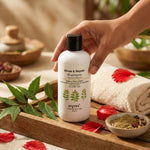
Rinse & Repair — Ayurvedic Anti-Dandruff Shampoo
Bhringraj, Neem, Methi, Amla and Tea Tree — Ayurveda's five most potent scalp herbs. No sulphates, no parabens. AYUSH approved, GMP certified. For a clean, balanced, healthy scalp.
✓ AYUSH Approved✓ FSSAI Registered✓ Sulphate-Free✓ Paraben-Free✓ 250ml
Buy Rinse & Repair — ₹849 →Frequently Asked Questions
How long does it take to see results after switching to a sulphate-free shampoo?
There are two phases. In the first 2–4 weeks, the scalp recalibrates its sebum output — this is an adjustment period where hair may feel greasier before it normalises. Most people see visible reduction in flaking within 3–6 weeks of consistent use. For the full anti-dandruff benefit of Neem and Tea Tree's antifungal action, allow 6–8 weeks of regular use, as the Malassezia population gradually reduces. Scalp itch typically improves before visible flaking does.
Will my hair feel less "clean" without sulphates?
During the 2–3 week transition period, yes — the scalp may feel less squeaky-clean as sebum production normalises. After the adjustment period, most people find their hair feels cleaner for longer between washes because the scalp is no longer in a constant strip-and-overcompensate cycle. "Squeaky clean" is actually a sign of an over-stripped scalp — it is the sound of dry friction, not cleanliness. A balanced scalp with intact lipid barrier will feel clean without that stripped sensation.
Is Ayurvedic anti-dandruff shampoo safe for colour-treated hair?
Sulphate-free shampoos are actually the recommended choice for colour-treated hair, because SLS and SLES are a primary cause of colour fading — they strip the hair shaft in the same way they strip the scalp. A sulphate-free, paraben-free Ayurvedic formulation with Bhringraj, Neem, and Methi will be significantly gentler on colour-treated hair than conventional anti-dandruff shampoos. The Neem content does not affect colour molecules. Tea Tree and Bhringraj extracts are also safe for chemically treated hair.
Can Rinse & Repair be used daily?
While Rinse & Repair is sulphate-free and gentle, we recommend washing 3–4 times per week for optimal scalp health — not because the shampoo is harsh, but because daily washing of any kind removes some natural oils. For urban Indian adults dealing with pollution and humidity, 3–4 times per week is the sweet spot: clean enough to prevent scalp buildup, infrequent enough to allow the acid mantle to maintain itself. During the initial transition from sulphate shampoos, you may want to wash slightly less frequently to allow the sebaceous glands to recalibrate.
What's the difference between dry dandruff and oily dandruff in Ayurveda?
Ayurveda distinguishes these as two distinct doshic patterns. Dry dandruff — fine, powdery, white flakes that worsen with cold weather, stress, and dehydration — is Vata-type Darunaka. The scalp is under-moisturised and over-stressed. Oily dandruff — larger, yellowish, greasy flakes that stick to the scalp, often accompanied by redness and itch — is Kapha-type Darunaka, driven by excess sebum and Malassezia. Most chronic dandruff in urban Indian adults is a mixed presentation (Kapha-Vata). Herbs like Bhringraj and Neem address both patterns, which is why they are the core of Ayurvedic anti-dandruff formulation rather than a single-dosha herb.